
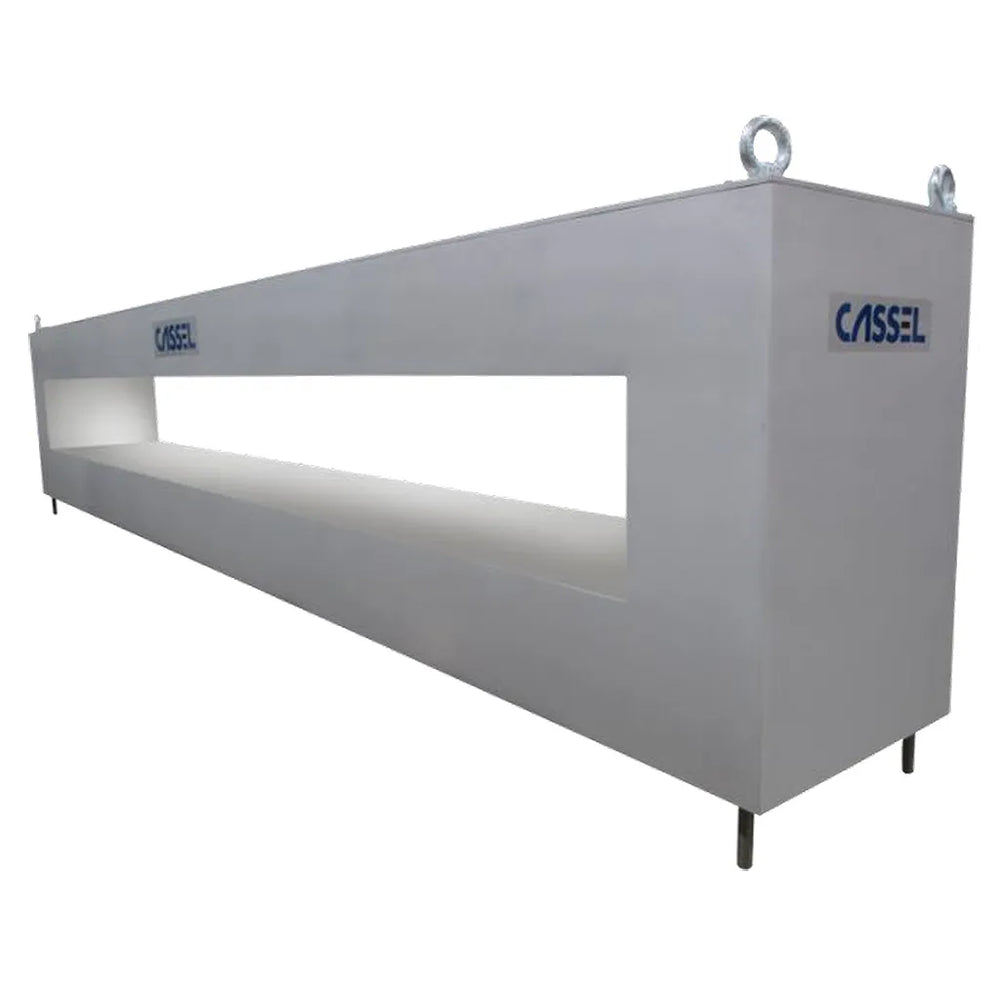
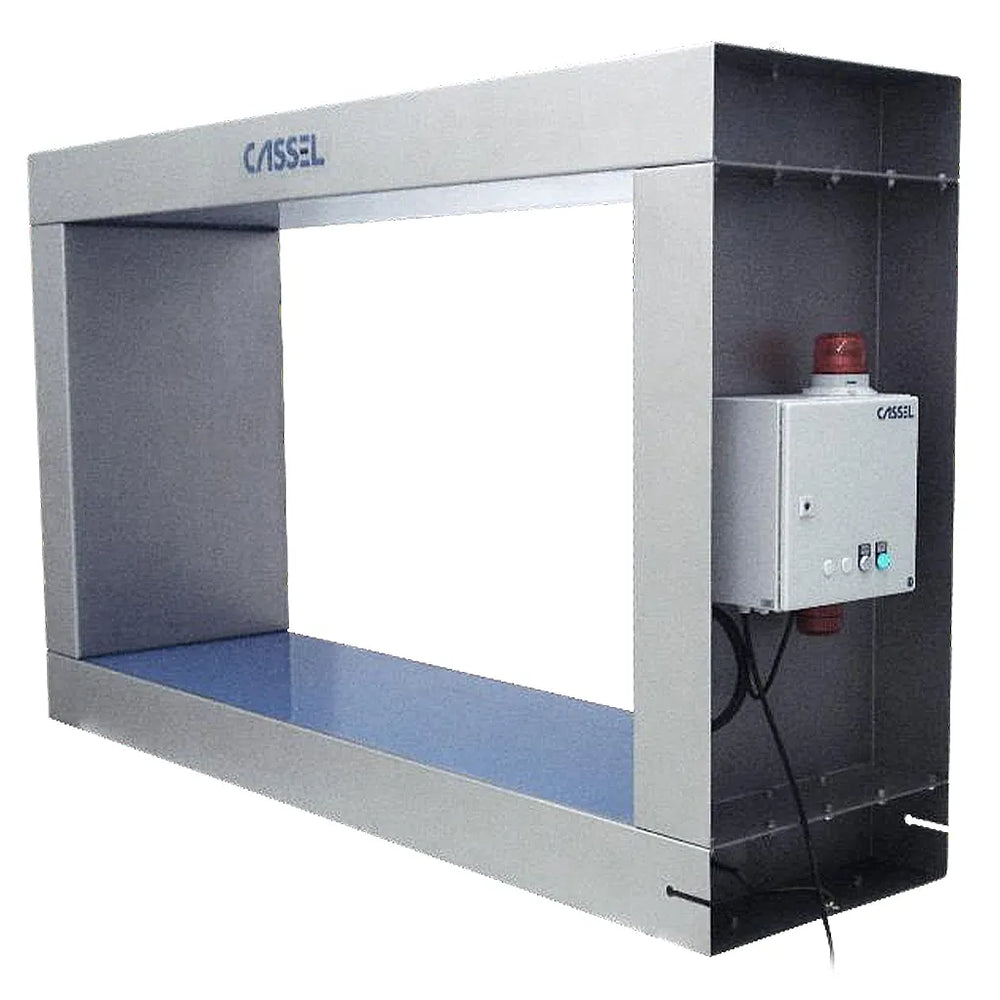
An industrial metal detection system identifies and removes metal contaminants from products during production, ensuring safety, quality, and regulatory compliance in manufacturing environments.
Cassel metal detection systems for food, pharmaceutical, and industrial production lines are supplied, installed, and serviced by Redemac's Canadian team.
Products
-
Sold out
-
-
-
-
-
-
-
-
-
Industrial Metal Detectors & Metal Locators for Sale in Canada
Redemac is Canada's trusted distributor of industrial metal detectors and metal locators for food, pharmaceutical, and industrial manufacturing. Our complete Cassel Metal Shark® range of metal detectors for sale covers every production format from conveyor systems for packaged goods to gravity-feed detectors for bulk dry products, pipeline metal locators for pumped liquids, and heavy-duty bulk systems for timber and recycling operations.
Every detector of metal in our range uses advanced multi-frequency electromagnetic technology to reliably identify ferrous, non-ferrous, and stainless-steel contaminants at full production speeds, protecting your downstream equipment, eliminating costly recalls, and keeping your HACCP audits clean. As the authorized Canadian supplier of Cassel systems, Redemac provides expert application engineering, on-site installation, operator training, and calibration validation so you get far more than just the hardware.
Whether you are investing in your first metal detector or replacing an aging system, our team will assess your product, line speed, aperture requirements, and regulatory obligations before recommending the right solution. Browse our full range of metal detectors in Canada below, or contact our team for a custom quote.
- Canadian distributor, local installation, service, and parts across all provinces, bilingual in English and French
- Cassel-authorized Factory-trained engineers on every system sold and installed
- HACCP & BRC compliant Systems certified to meet all major food safety audit standards
- Full integration Pairs with Redemac checkweighers, X-ray, and print-and-apply systems
- Lifetime support, service contracts, annual validation, and Canadian spare-parts inventory
What Is an Industrial Metal Detector?
An industrial metal detector, also called a metal locator, is an inline inspection system that uses a balanced electromagnetic coil to detect metallic contaminants inside products moving through a production line aperture. When a ferrous, non-ferrous, or stainless-steel particle disturbs the electromagnetic field, the detector triggers an automatic rejection mechanism to remove the contaminated unit before it reaches packaging or dispatch.
Unlike handheld or hobby metal detectors, production-grade systems operate continuously at high conveyor speeds without interrupting output. They are a critical component of HACCP Critical Control Points (CCPs) and are required under food safety standards, including BRC, SQF, IFS, and FDA FSMA regulations. In non-food sectors, including timber, textiles, and plastics extrusion, metal locators protect expensive downstream equipment from catastrophic damage caused by tramp metal contamination.
The terms "metal detector" and "metal locator" refer to the same category of industrial inspection equipment. "Metal locator" is more commonly used in industrial and bulk-material handling contexts, while "metal detector" is the standard term in food and pharmaceutical manufacturing. Both systems operate on identical electromagnetic detection principles.
Why metal detection matters in manufacturing?
Metal contamination in a manufactured product can originate from many sources: worn machine components, broken tooling, wire fragments from conveyor belts, work-in-progress packaging materials, or raw ingredient contamination. Even a sub-millimetre ferrous fragment in a food product can cause serious consumer injury and trigger a regulatory recall.
For manufacturers, the consequences of an undetected metal contaminant are severe recalls, reputational damage, regulatory penalties, and potential civil liability. For consumers, the consequences can be physical injury. Industrial metal detectors eliminate this risk by continuously inspecting 100% of product output at the point of production, before the product reaches the consumer.
Beyond consumer safety, metal detection also protects capital equipment. In industries such as plastics extrusion, timber processing, and mineral recycling, a single piece of tramp metal passing through an unprotected extruder, grinder, or press can cause thousands of dollars of damage and days of unplanned downtime. A metal locator installed upstream of critical equipment pays for itself in prevented damage.
How Does a Metal Detector Work?
Industrial metal detectors use a balanced three-coil electromagnetic system to detect metallic contaminants without contact. Understanding how this system works helps manufacturers select the right configuration for their product and production environment.
The three-coil system
Inside every industrial metal detector aperture are three coils arranged in a specific configuration: one transmitter coil in the centre and two identical receiver coils on either side. The transmitter coil generates a high-frequency alternating magnetic field. In normal operating conditions with no metal present, the two receiver coils are perfectly balanced by the transmitter field and produce no output signal.
When a metallic particle passes through the aperture, it disturbs this electromagnetic balance. The metal absorbs and re-emits a portion of the magnetic field energy differently to each receiver coil, creating an imbalance in the output signals. The detector's signal processing electronics register this imbalance as a contamination event and trigger the automatic rejection system.
Multi-frequency technology
Modern metal detectors like the Cassel Metal Shark® range transmit multiple electromagnetic frequencies simultaneously. This is a critical advancement for applications involving conductive or high-moisture products. Wet products, including fresh meat, cheese, and pickled vegetables, generate their own electromagnetic signal as they pass through the aperture. This signal is called the "product effect" and, if not compensated for, can mask the signal of a small metal contaminant or trigger false rejections.
Multi-frequency operation allows the detector's software to analyse the phase angle and amplitude of signals across multiple frequencies simultaneously, distinguishing the product effect from the signature of a genuine metal contaminant. The system automatically learns and compensates for the product effect during a product-setting procedure, then maintains sensitivity to metal signals throughout the production run.
Automatic rejection and data logging
When the detector identifies a contamination event, it activates a rejection device calibrated to the precise conveyor position of the contaminated product to remove it from the production line without stopping output. Common rejection mechanisms include air-blast ejectors (for small, lightweight products), diverter flap systems (for mid-weight products on a belt), and pusher arm or drop-flap systems (for larger or heavier items).
Every detection and rejection event is automatically logged with a timestamp, product identity, conveyor speed, and signal strength data. This data log forms the basis of the audit trail required by food safety and pharmaceutical regulatory standards. Cassel detectors with Redemac's configuration also support remote monitoring and data export to production management systems.
Detection sensitivity benchmarks
- Ferrous metal: detectable from a 0.3 mm diameter sphere at the aperture centre
- Non-ferrous metal (aluminium, copper, brass): detectable from 0.4 mm diameter
- Stainless steel (316 grade): detectable from 0.5 mm diameter
- Detection confidence: 100% of detectable particles trigger rejection when the system is correctly set and validated
Types of Metal Detectors for Sale
Redemac stocks the complete Cassel Metal Shark® range, the most comprehensive industrial metal detector lineup available from a single manufacturer. Each system is available in custom aperture sizes and with a choice of rejection mechanisms to suit your specific production layout.
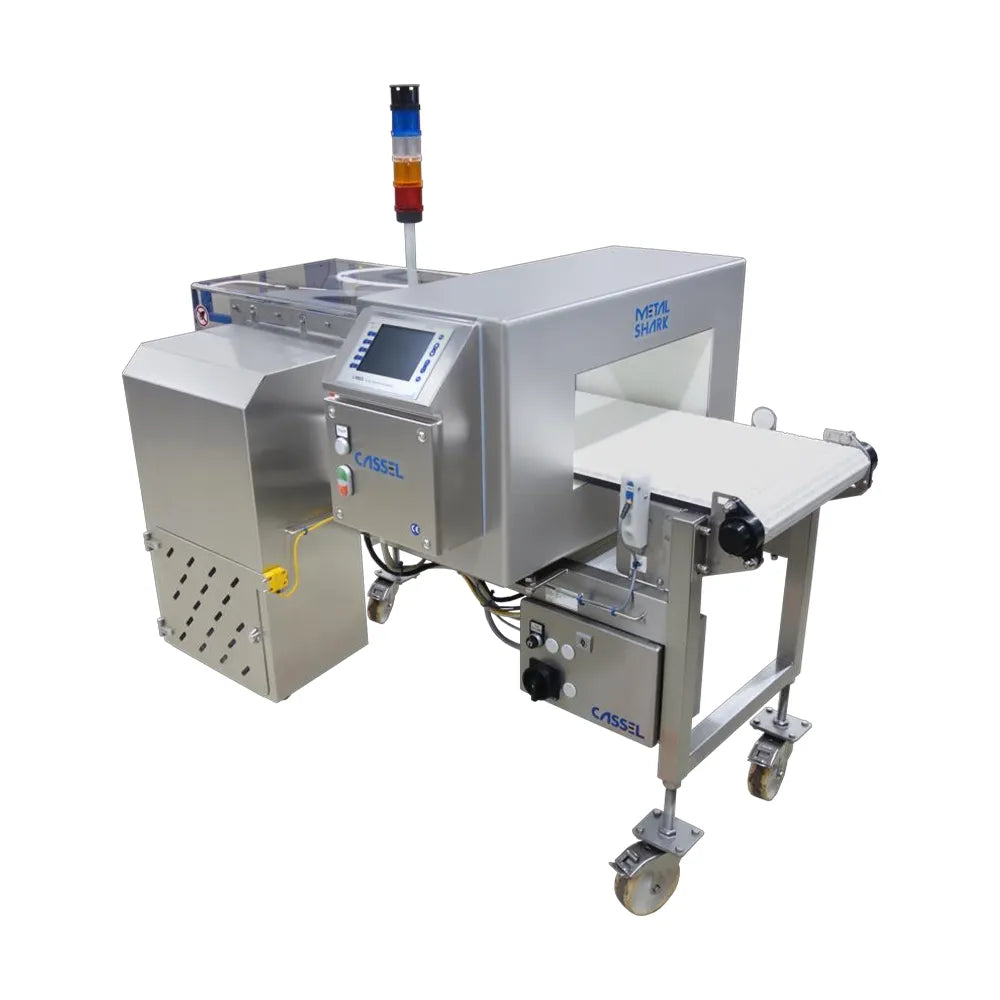
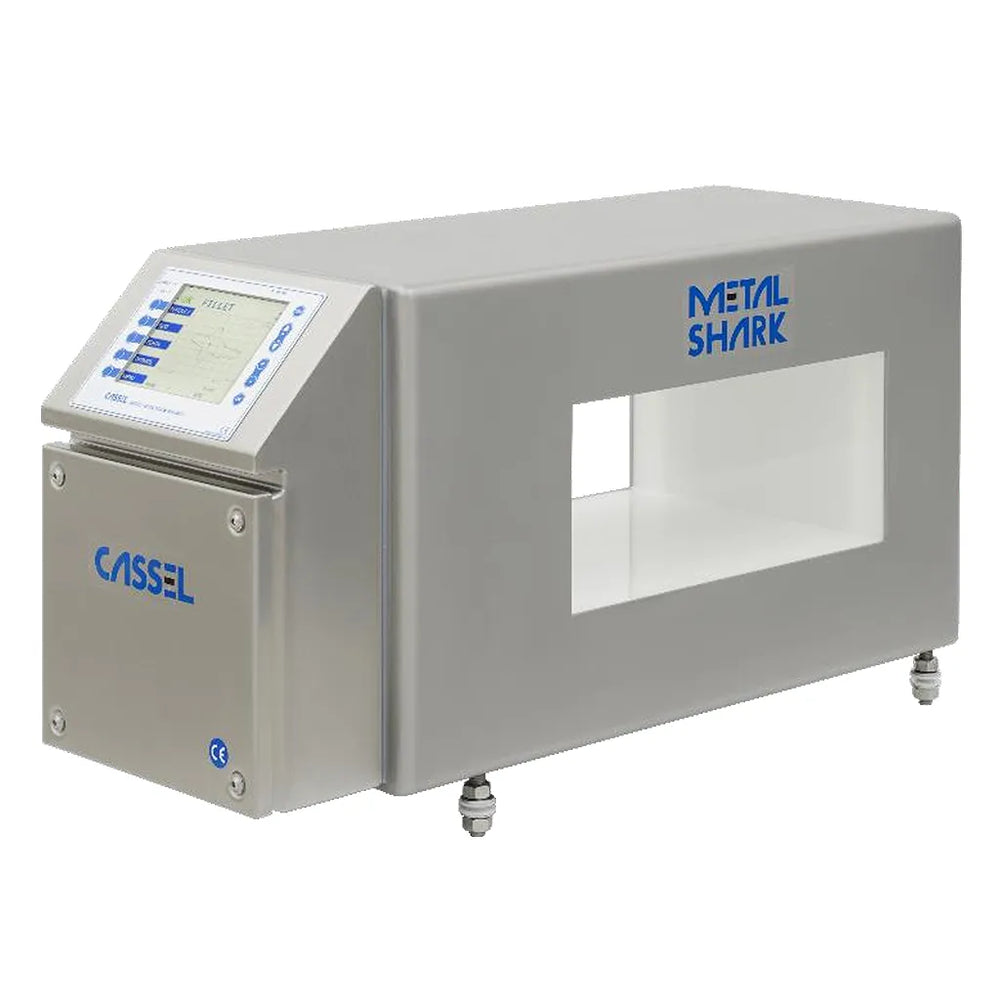
Conveyor metal detectors Metal Shark® BD / Conveyor HQ
Conveyor metal detectors are the most widely deployed configuration in food and consumer goods manufacturing. The product moves through the detector on a belt conveyor, passing through the detection aperture. The Cassel Metal Shark® BD is a modular conveyor detector that can be integrated into existing conveyor lines; the Conveyor HQ is an all-in-one system with the detector and conveyor built into a single compact unit, ideal for space-constrained lines.
Suitable products and applications include packaged meat, poultry, and seafood; wrapped dairy and cheese portions; bakery products in trays or bags; frozen ready meals; canned and jarred goods; confectionery; pet food in bags or pouches; and any other packaged, wrapped, or boxed product moving on a conveyor. Aperture widths and heights are customized to your packaging format.
- Key standards: BRC, SQF, IFS, HACCP CCP, FSMA, CFIA preventive control requirements
- Rejection options: Air blast, diverter flap, pusher arm, stop-on-detect
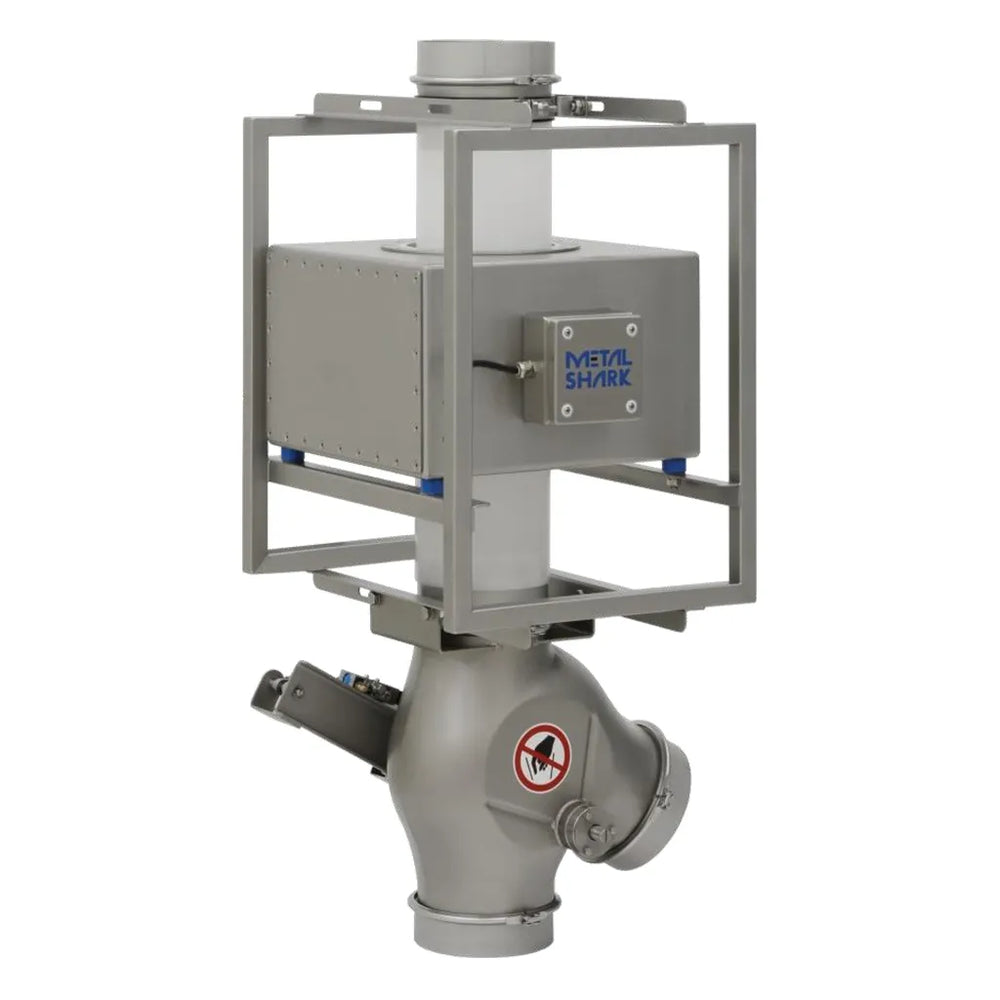
Gravity-feed / free-fall metal detectors Metal Shark® GF
Gravity-feed metal detectors, also called free-fall detectors, are designed for dry, free-flowing bulk products that are conveyed vertically under gravity. The product falls through a vertical detection aperture, providing optimal sensitivity because there is no conveyor belt, product contact surface, or mounting structure inside the detection zone to create interference signals.
Because the product passes through the centre of the aperture at high speed, gravity-feed systems achieve the highest sensitivity of any metal detector configuration. They are ideal for bulk powders, grains, seeds, coffee beans, spices, nuts, rice, flour, sugar, and any other dry ingredient that flows freely. The Metal Shark® GF is typically installed above a filling, dosing, or packaging machine so that detected metal is rejected before the product is packaged.
- Key advantage: Highest detection sensitivity of any metal detector type due to zero product contact inside the aperture
- Common installation: Above vertical form-fill-seal machines, dosing systems, bag-filling stations
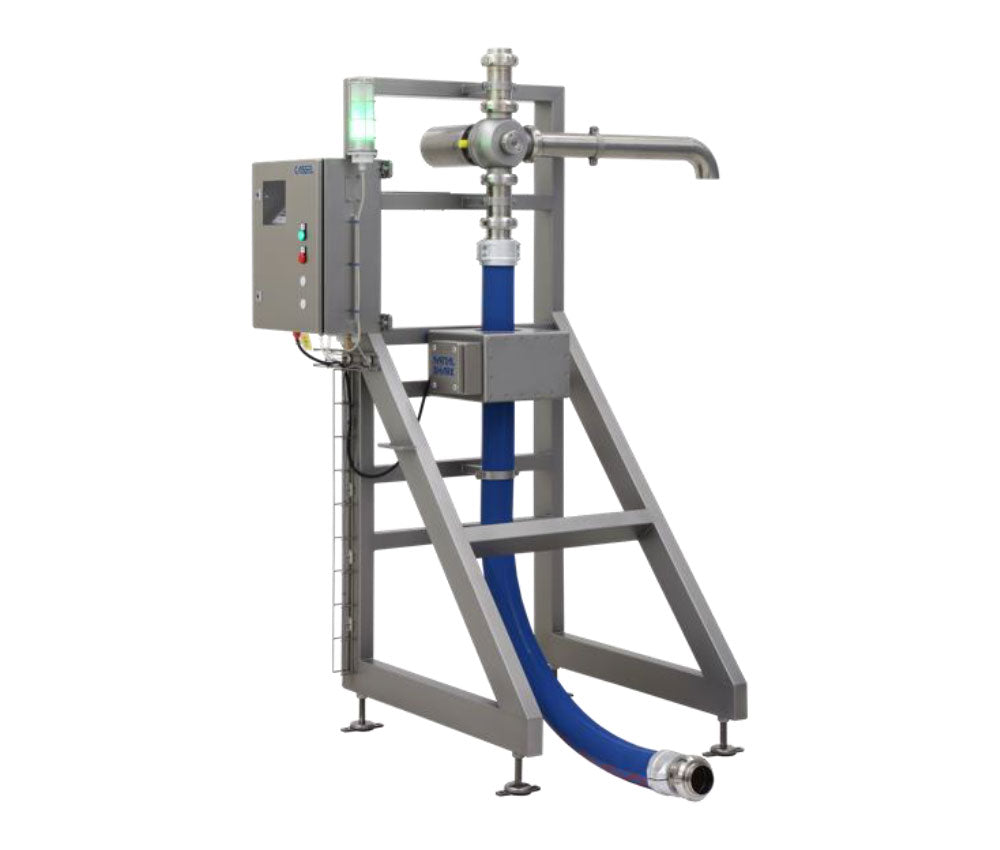
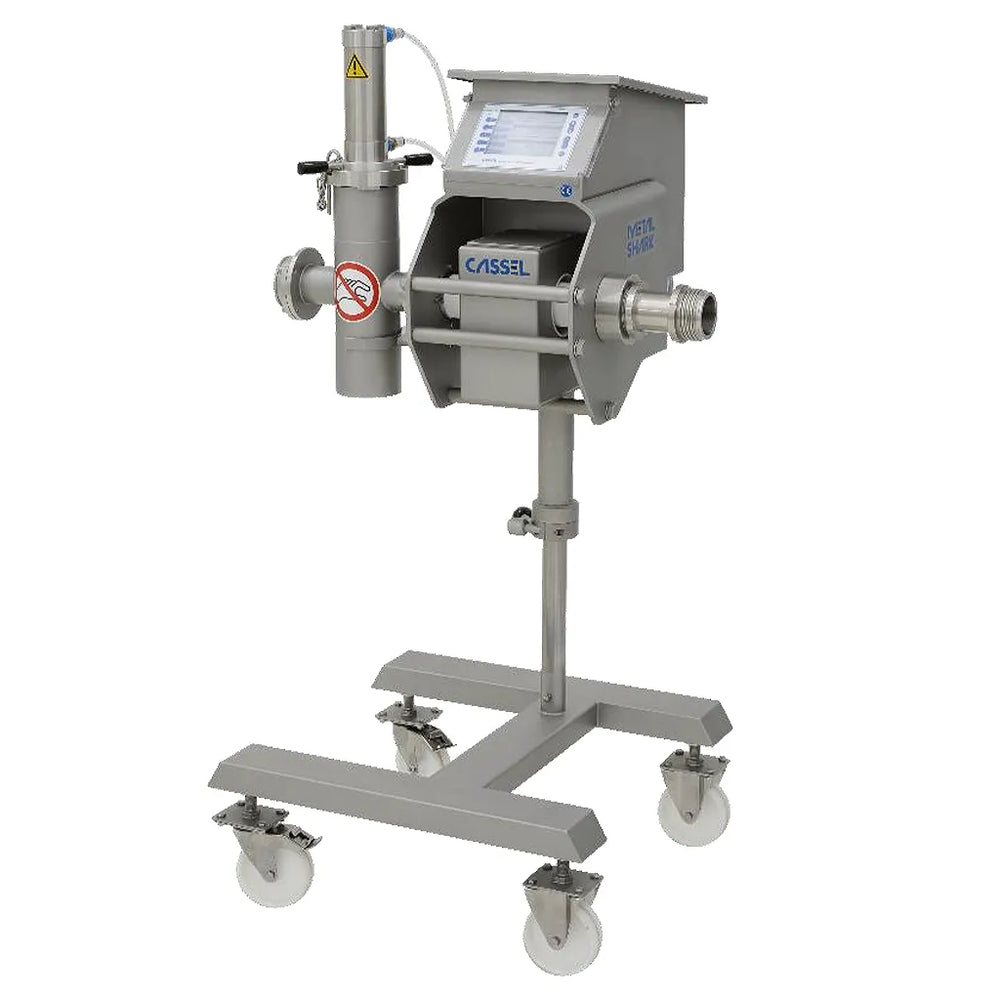
Pipeline / in-liquid metal detectors Metal Shark® In Liquid
Pipeline metal detectors are designed to inspect products that are pumped rather than conveyed, including liquids, pastes, emulsions, slurries, and semi-liquid products. The Metal Shark® In Liquid installs directly inline with the product pipeline, allowing the flowing product to pass through the detection aperture under pump pressure. Detection occurs without any interruption to the flow rate.
The system is constructed entirely from 316L food-grade stainless steel with fully hygienic internal surfaces and supports CIP (clean-in-place) and SIP (steam-in-place) cleaning procedures. It handles operating pressures up to 25 bar and product temperatures up to 135°C, making it suitable for high-temperature processing and aseptic applications.
Typical applications include liquid dairy products (milk, cream, liquid cheese), fruit juice and concentrates, sauces, soups, ketchup, mayonnaise, edible oils, liquid pharmaceutical formulations, and cosmetic liquids and gels.
- Pipeline pressure rating: Up to 25 bar operating pressure
- Cleaning: Full CIP and SIP compatible, no disassembly required for cleaning
In-Meat Metal Detectors Metal Shark® In Meat
Meat products present the most challenging detection environment of any food application. Fresh, chilled, and frozen meat contains high levels of water and salt, generating a very strong product effect that can mask small metal contaminants. Brine-injected products, including cured hams, marinated poultry, and injected beef, compound this challenge with high ionic conductivity.
The Cassel Metal Shark® In Meat is engineered specifically for these conditions, using advanced phase-angle multi-frequency technology and automatic product tracking to continuously compensate for the variable product effect of bone-in, brine-injected, and tumbled meat products. It maintains reliable sensitivity to metal contaminants, including broken brine injection needle fragments, which represent the most critical contamination hazard in processed meat facilities, even on the most conductive products.
The system meets all requirements of the British Retail Consortium Global Standard for Food Safety and is designed to integrate with existing meat processing conveyors without modification to the line layout.
- Critical application: Detection of broken brine injection needle fragments, a primary HACCP CCP for processed meat
- Detection of high-brine products: Maintained sensitivity on NaCl concentrations up to saturation
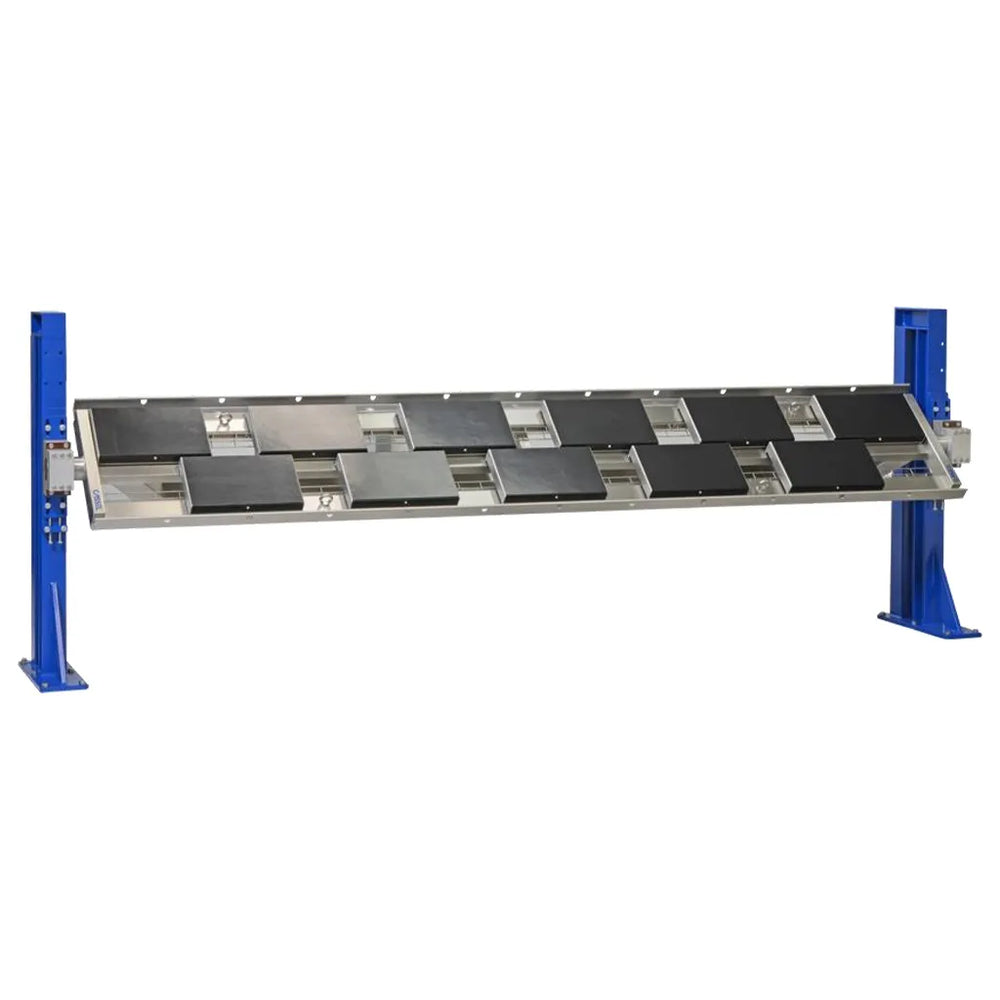
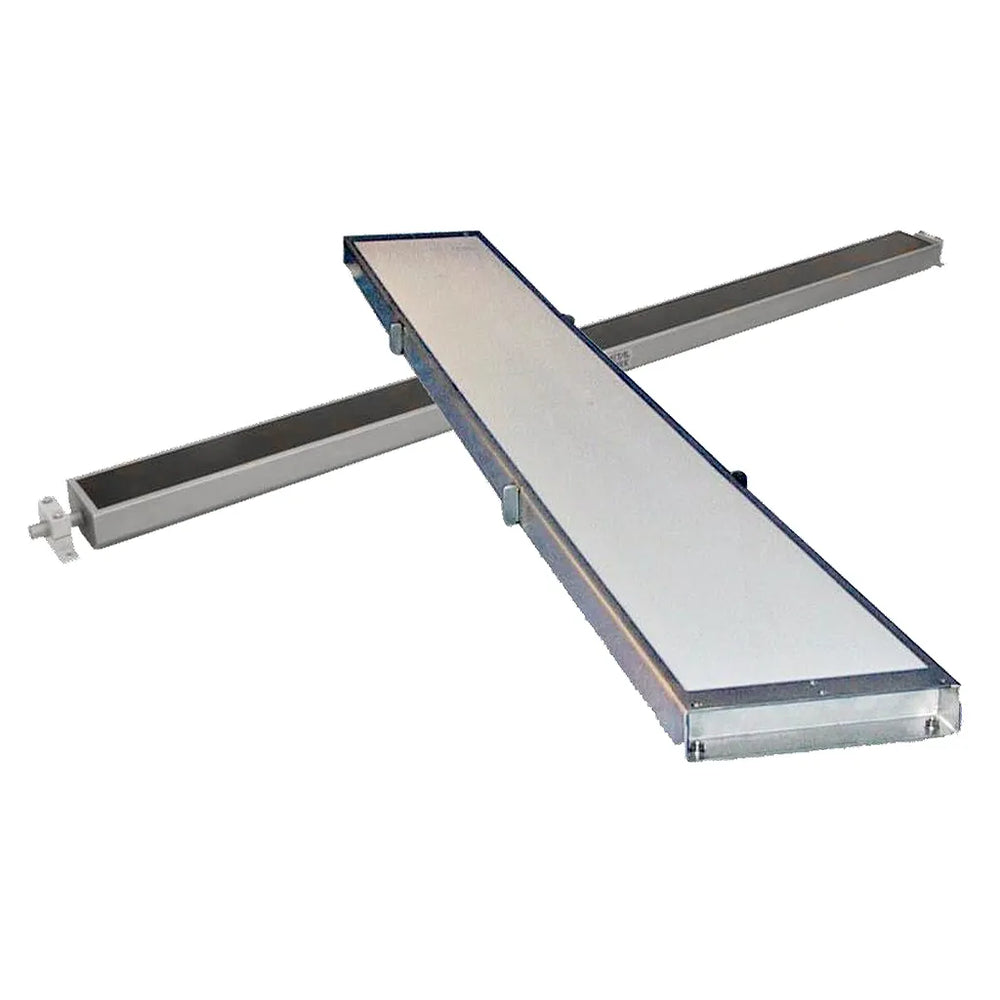
Web and flat-product metal locators Metal Shark® FL / Combi
Web detectors are designed for continuous material that moves through the aperture as a flat sheet or roll rather than as discrete units. The Metal Shark® FL uses a flat, wide-aperture detection head to scan the full width of the web as it passes through at production speed. It detects ferrous, non-ferrous, and stainless-steel contamination within the web and triggers a line stop or marking system to indicate the contaminated section.
The Metal Shark® Combi is a dual-channel system that combines detection capability for both textile and paper webs in a single frame, serving converters and mills that process multiple material types on the same line.
Applications include packaging film extrusion (LDPE, BOPP, PET, aluminium foil laminate), paper and board manufacturing, nonwoven fabric production, textile weaving and knitting mills, and rubber sheet manufacturing.
- Web width coverage: Available in widths from 300 mm to 3,000 mm
- Line speed: Compatible with web speeds up to 600 m/min
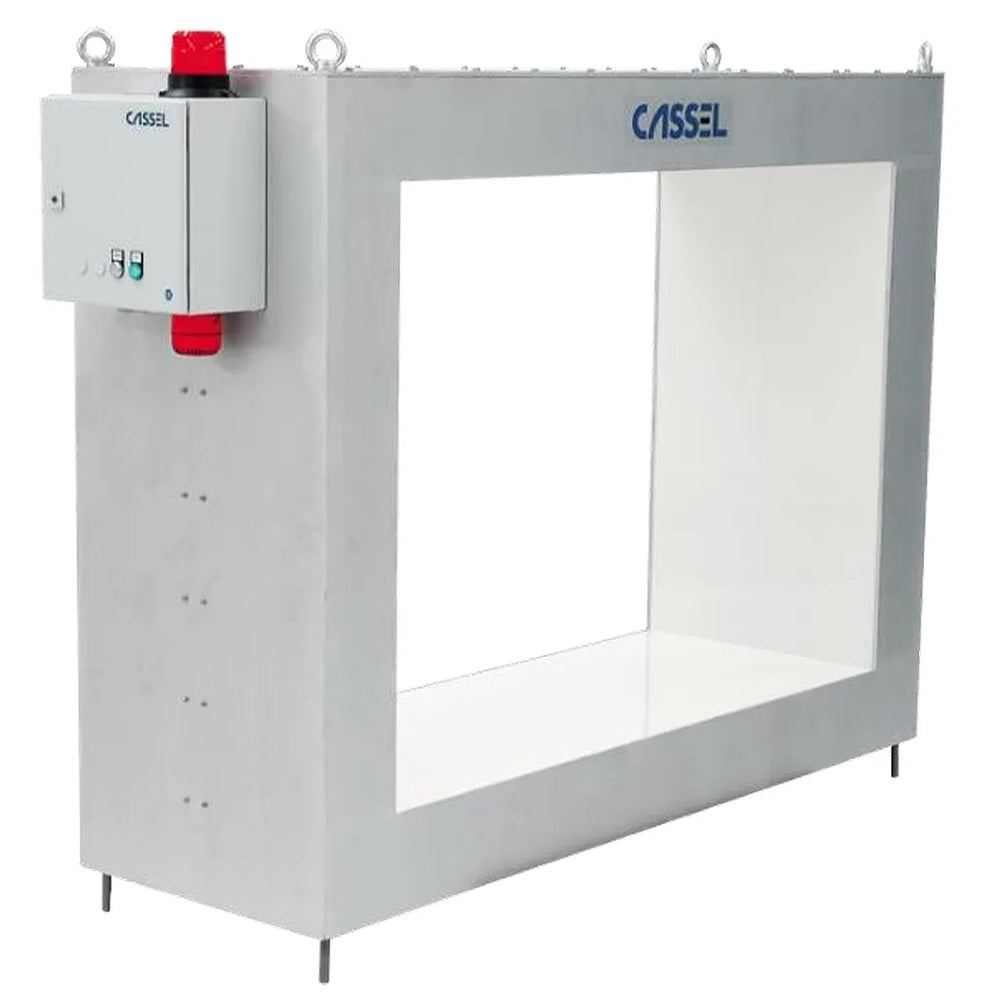
Heavy-duty bulk metal detectors Metal Shark® BIG / BIG pba
The Metal Shark® BIG range is designed for large-aperture detection in heavy industrial and bulk material handling applications, where the primary purpose is equipment protection rather than product quality control. In operations such as wood processing, aggregate crushing, mineral sorting, and plastic recycling, a single piece of tramp metal, a nail, bolt, wire fragment, or metal shim can cause catastrophic and expensive damage to shredders, granulators, presses, and cutting machines.
The BIG pba variant is optimized specifically for wood panel and MDF (medium-density fibreboard) manufacturing, where the product effect of wood-based materials and metallic binders creates a challenging detection environment. Special signal processing algorithms suppress the wood product effect while maintaining maximum sensitivity to tramp metal contaminants.
- Aperture sizes: Available up to 1,400 mm wide and 500 mm high for large-format bulk conveyors
- Rejection: Line stop, alarm, and automatic diverter options for bulk material rejection
Non-separable conveyor metal detector Metal Shark® TU
The Metal Shark® TU solves a specific installation challenge: how to detect metal in a product that cannot be removed from its conveyor. Standard tunnel-aperture detectors require the product to pass through the detection head on a belt that enters and exits the aperture. But products conveyed on chain conveyors, pin conveyors, mesh belts, or hanging rails cannot be separated from their carriers without a complete line redesign.
The TU model uses a detection head geometry that accommodates the conveyor structure passing continuously through the aperture, using adaptive signal processing to ignore the metallic signature of the chain, pins, or mesh while remaining fully sensitive to contaminants within the product itself. This allows metal detection to be integrated into existing line layouts without any conveyor modification.
Typical applications: Hanging poultry lines, chain-conveyed bakery pans, mesh-belt freeze-tunnel conveyors, pin-frame textile conveyors
Frequently Asked Questions
What is an industrial metal detection system?
How does a metal detector work in production lines?
Metal detectors use electromagnetic fields to detect metal contaminants. When metal is detected, the system triggers an alert or automatically rejects the contaminated product from the line.
What types of metals can be detected?
Industrial metal detectors can detect ferrous metals, non-ferrous metals like aluminum and copper, and even stainless steel, depending on the system’s sensitivity.
Why is metal detection important in manufacturing?
Metal detection helps prevent contamination, protects consumers, avoids costly recalls, and ensures compliance with food safety and quality standards.
Which industries use metal detection systems?
Metal detection systems are commonly used in food processing, pharmaceuticals, packaging, plastics, and other industrial manufacturing sectors.
Can metal detectors be integrated into existing production lines?
Yes, most modern metal detection systems can be easily integrated into conveyors, pipelines, and automated production lines without disrupting operations.
What are the benefits of using a metal detection system?
Key benefits include improved product safety, reduced equipment damage, better quality control, and lower long-term operational risks.
Do metal detection systems meet industry regulations?
Yes, industrial metal detection systems are designed to comply with standards such as HACCP, BRC, and IFS to ensure product safety and regulatory compliance.